
Abstrak
A vehicle's control arm is a pivotal component of the suspension system, linking the chassis to the wheel hub and guiding the wheel's vertical movement. Its integrity is paramount for vehicle stability, handling precision, dan keselamatan keseluruhan. This document provides a comprehensive analysis of the symptomatic manifestations of a failing control arm. It methodically examines the auditory, sentuhan, and visual indicators that signal wear or damage. Key symptoms discussed include clunking or popping noises during transit, steering wheel vibrations, and unpredictable steering behavior such as wandering. The analysis extends to visual inspection techniques for identifying physical damage, deteriorated bushings, and failed ball joints, along with the consequential pattern of uneven tire wear. The discussion differentiates these symptoms from those of other related suspension components, offering a structured framework for accurate diagnosis. This guide is intended to equip vehicle owners and technicians with the necessary knowledge for early detection, thereby preventing catastrophic failure and ensuring the continued safe operation of the vehicle.
Takeaways utama
- Listen for clunking, muncul, or creaking sounds, especially over bumps or during turns.
- Feel for steering wheel vibrations or a tendency for the vehicle to wander or pull.
- Visually inspect bushings for cracks and ball joint boots for tears or grease leaks.
- Check for uneven tire wear, particularly on the inner or outer edges of the tires.
- Understanding how to tell if a control arm is bad is vital for vehicle safety.
- When replacing components, consider using high-quality control arms to ensure longevity.
- Always perform a wheel alignment after replacing any control arm components.
Jadual Kandungan
- Understanding the Control Arm's Role in Your Vehicle
- 1. Petunjuk pendengaran: Deciphering the Sounds of Failure
- 2. Maklum balas sentuhan: Feeling the Problem Through the Steering Wheel
- 3. Bukti visual: Inspecting for Wear and Damage
- 4. Performance Degradation: A Decline in Ride Quality and Handling
- 5. Diagnostic Confirmation: Advanced Checks for DIY and Professionals
- Soalan yang sering ditanya (Soalan Lazim)
- A Concluding Thought on Proactive Maintenance
- Rujukan
Understanding the Control Arm's Role in Your Vehicle
To truly grasp how to tell if a control arm is bad, one must first appreciate its profound role within the complex ecosystem of a vehicle's suspension. Think of the suspension system as the vehicle's musculoskeletal structure. It bears the vehicle's weight, absorbs shocks from the road surface, and dictates how the wheels interact with the ground. Dalam sistem ini, the control arms are akin to the primary limbs—the humerus or femur of the car—connecting the stationary frame to the dynamic wheel assembly.
These arms, often called A-arms due to their triangular shape, serve as a critical pivot point. They allow the wheels to move vertically to absorb bumps and undulations in the road while simultaneously holding them in the correct alignment for stable steering and traction (Pasukan Penyelidik CarParts.com & McCuistian, 2025). This dual function is what makes them so fundamental to both comfort and control.
Suspension Designs and Control Arm Configuration
The number and placement of control arms can vary based on the suspension design, which is a choice made by automotive engineers to balance cost, prestasi, and space.
- Macpherson Strut: This is a very common design in modern front-wheel-drive cars. It utilizes a single, robust lower control arm for each wheel. The strut assembly itself (a shock absorber integrated with a coil spring) acts as the upper pivot point. This design is compact and cost-effective but offers less geometric control during aggressive cornering compared to its more complex counterpart.
- Double Wishbone: Found in many performance cars, trucks, and SUVs, this system uses two control arms for each wheel—an upper and a lower arm. This setup provides superior control over the wheel's camber angle (the tilt of the wheel) as it moves up and down, maximizing the tire's contact patch with the road for better grip and handling (Juye Parts, 2024).
| Ciri | Penggantungan MacPherson Strut | Penggantungan Double Wishbone |
|---|---|---|
| Control Arms | One lower control arm per wheel | One upper and one lower arm per wheel |
| Kerumitan | Simpler, fewer components | More complex, more pivot points |
| Kos | Generally lower manufacturing cost | Higher manufacturing and maintenance cost |
| Prestasi | Good for most driving; less precise | Excellent handling and stability |
| Penggunaan Biasa | Economy cars, many sedans | Sports cars, trucks, Kenderaan mewah |
The Anatomy of a Control Arm Assembly
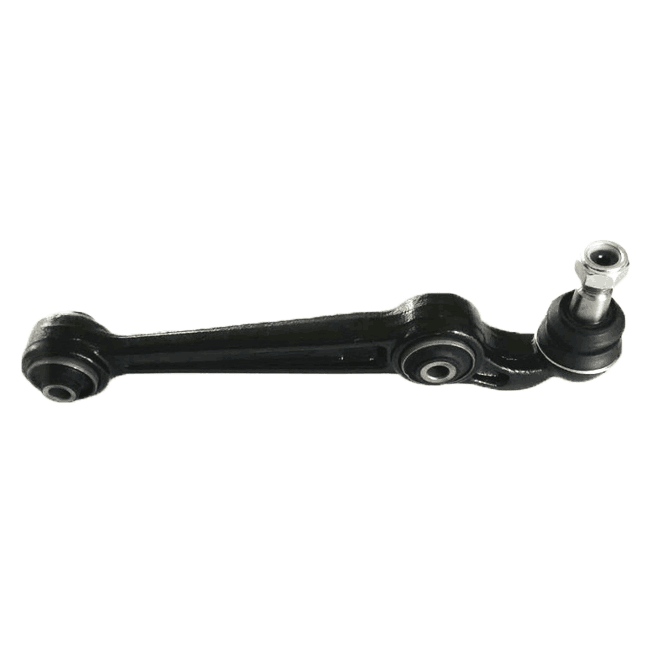
A control arm is not just a piece of metal; it is an assembly of parts working in concert. The arm itself is typically made from one of three materials, each with distinct properties.
| Material | Kelebihan utama | Kelemahan Utama | Permohonan biasa |
|---|---|---|---|
| Stamped Steel | Kos rendah, good flexibility | Prone to rust if not coated | Most standard passenger cars |
| Besi tuang | Extremely strong and durable | Berat, adds to unsprung weight | Trak, SUV, Kenderaan tugas berat |
| Cast Aluminum | Ringan, tahan kakisan | Less flexible, can crack on impact | Prestasi dan kenderaan mewah |
Attached to the control arm are two other vital components:
- Bushings: These are rubber or polyurethane cylinders that connect the wide end of the control arm to the vehicle's frame. Think of them as cartilage in a joint. They absorb vibrations, reduce noise, and allow the arm to pivot smoothly. When they wear out, the "joint" becomes loose and noisy.
- Sendi Bola: Located at the narrow end of the arm, the ball joint connects to the steering knuckle (the part the wheel hub and brake assembly attach to). It is a ball-and-socket joint that allows the wheel to be steered left and right while also moving up and down with the suspension. A worn ball joint is a significant safety hazard, as complete failure can cause the wheel to detach from the suspension (Mazzella, 2023).
Now that we have a foundational understanding of what a control arm is and what it does, we can more meaningfully explore the signs that indicate it has gone bad.
1. Petunjuk pendengaran: Deciphering the Sounds of Failure
One of the first and most common ways a vehicle communicates distress is through sound. A failing control arm is often quite vocal, producing a range of noises that can serve as early warnings. Learning to interpret these sounds is a key step in diagnosing the problem before it escalates.
Popping and Clunking Noises
This is the classic symptom of a worn control arm component, particularly a bad ball joint or severely degraded bushings. You will most likely hear a distinct "clunk" or "pop" apabila memandu di atas benjolan, berlubang, or even just an uneven driveway at low speeds (Mazzella, 2023).
What is happening to cause this sound? Imagine a loose joint in a piece of furniture. When you put weight on it, it shifts and makes a noise. The same principle applies here. A worn ball joint has excessive play in its socket. As the suspension compresses and rebounds over a bump, the ball stud inside the socket moves around and impacts the inner walls, creating a sharp clunking sound. Begitu juga, if a control arm bushing has deteriorated, the metal sleeve inside the bushing can knock against the control arm or the vehicle frame, producing a duller thud or clunk. You may also hear this noise during sharp turns or when accelerating or braking, as the forces shift the weight of the vehicle and cause the loose component to move.
Squeaking and Creaking Sounds
A squeaking or creaking noise, often likened to an old door hinge, typically points to a different mode of failure. This sound is often more persistent and can be heard when the suspension moves up and down, such as when going over speed bumps or even just when getting in or out of the car.
This creaking is usually caused by the metal-on-metal or metal-on-hardened-rubber friction of a dry or worn-out ball joint or bushing. The grease inside a ball joint can dry up or leak out, leaving the metal surfaces to rub against each other. Likewise, as rubber bushings age, they can harden and lose their flexibility, causing them to squeak as the control arm pivots. While less alarming than a loud clunk, this sound is a clear indication that the components are no longer moving as smoothly as they should and are in need of inspection.
Differentiating from Other Suspension Noises
A challenge for any diagnostician, amateur or professional, is that other suspension parts can make similar noises. A bad stabilizer link, for instance, can also produce a clunking sound over bumps. A worn tie rod end can create a clunk when turning. Jadi, how can you begin to tell the difference?
- Stabilizer Link Noise: This is often a lighter, more "rattly" clunk than the solid thud of a bad control arm. It is almost exclusively heard when one wheel hits a bump independently of the other, as the stabilizer bar's job is to resist body roll.
- Tie Rod End Noise: A worn outer tie rod end will often make a clunking noise or feel loose when you turn the steering wheel, walaupun ketika tidak bergerak. It can also produce a clunk during low-speed maneuvers.
- Shock/Strut Noise: A failing shock absorber or strut mount can also cause clunking. A bad strut mount, in particular, can make noise when turning the steering wheel as well as over bumps.
While listening is a great first step, it often takes a combination of auditory clues and physical inspection to definitively determine how to tell if a control arm is bad.
2. Maklum balas sentuhan: Feeling the Problem Through the Steering Wheel
Beyond what you can hear, a failing control arm often sends signals you can feel directly through the steering wheel and the chassis of the car. Your hands on the wheel are sensitive instruments, and paying attention to changes in steering feel can provide crucial diagnostic information.
Getaran Roda Stereng
One of the most unsettling symptoms is a vibration felt in the steering wheel, particularly at higher speeds. This is often a sign of worn control arm bushings (TGQ, 2024). The bushings are responsible for isolating the cabin from road imperfections and high-frequency vibrations from the tires. When they wear out, they lose their dampening properties.
What you feel is the direct result of this failure. The worn bushings allow for small, rapid movements or oscillations of the control arm that are then transmitted up through the steering knuckle, batang pengikat, steering rack, and finally to the steering column and the wheel in your hands. This vibration may be constant at highway speeds or it might come and go as you drive over different road surfaces. It's often confused with an out-of-balance tire, but a key difference is that a vibration from a bad bushing may change or worsen during braking or acceleration, as the forces on the control arm shift.
Steering Wander and Instability
Perhaps the most dangerous symptom of a bad control arm is a loss of steering precision. You might find yourself constantly making small corrections to the steering wheel just to keep the car driving in a straight line. This phenomenon is known as "steering wander" (Mazzella, 2023).
This instability is a direct consequence of worn ball joints or bushings allowing the wheel's alignment to change dynamically as you drive. A healthy suspension holds the wheels at precise angles (Camber, caster, dan kaki) set during a wheel alignment. A bad control arm allows the wheel to wobble or shift from these settings. When the wheel's toe angle, contohnya, is constantly changing, the car will want to drift left or right, forcing you to correct it. This can be especially noticeable and frightening on uneven roads or in crosswinds, where the car may feel "darty" and unpredictable.
Memory Steer or Poor Steering Return
Another subtle but important tactile clue is a change in how the steering wheel behaves after a turn. In a healthy car, after you complete a turn, the steering wheel should naturally want to return to the center position. This is due to the caster angle of the front wheels.
A failing control arm, particularly a seized or binding ball joint, can interfere with this action. If a ball joint is rusted or has lost its lubrication, it may not pivot freely. This can cause the steering to feel stiff or to "stick" in a turned position, a condition sometimes called "memory steer." You have to manually force the wheel back to the center instead of letting it glide back on its own. This indicates a serious problem with a key pivot point in your suspension and steering system.
3. Bukti visual: Inspecting for Wear and Damage
While listening and feeling are essential, a definitive diagnosis often requires a visual inspection. You don’t always need to be a master mechanic to spot the signs of a bad control arm. With a good flashlight and an understanding of what to look for, you can gather a wealth of information. For safety, always ensure the vehicle is securely supported on jack stands before getting underneath it.
Visible Damage to the Control Arm Body
The control arm itself is a robust piece of metal, but it is not indestructible. A significant impact with a curb, a deep pothole, or road debris can bend or crack the arm (Pasukan Penyelidik CarParts.com & McCuistian, 2025). A bent control arm will throw your wheel alignment completely out of specification, leading to severe steering pull and rapid tire wear.
Look along the length of the arm for any signs of bending, retak, or heavy corrosion, especially on stamped steel arms. Compare the suspect arm to the one on the other side of the vehicle; they should be symmetrical. Any visible deformation is a clear sign that the entire control arm assembly needs to be replaced.
Worn or Damaged Bushings
The control arm bushings are often the first part of the assembly to fail. They live a hard life of constant movement and exposure to the elements. Visually inspecting them can be very revealing.
Look for large cracks, mengoyak, or chunks of missing rubber. A healthy bushing should look solid. You might also see that the center metal sleeve has shifted and is no longer centered within the rubber, or that the rubber has become oblong instead of round. Another tell-tale sign is fluid leakage if your vehicle is equipped with fluid-filled hydraulic bushings, which are used in some vehicles for enhanced damping. Any oily residue around the bushing indicates it has failed.
Failed Ball Joints
The ball joint is protected by a rubber or neoprene boot that holds grease in and keeps dirt and water out. The health of this boot is a primary indicator of the ball joint's condition.
Inspect the boot carefully. If it is torn, ripped, or missing, the joint is compromised. Dirt and water will have entered, and the lubricating grease will have escaped. This will cause rapid wear and eventual failure. Even if the boot is intact, you can check for excessive play. With the vehicle's weight off the wheels (supported by jack stands), you can try to move the wheel by hand. A pry bar can also be used by a technician to check for movement in the joint, which is a more definitive test (Mazzella, 2023). Any noticeable play or looseness in the ball joint means it is bad.
Uneven Tire Wear Patterns
Your tires can tell a story about the health of your suspension. A bad control arm will disrupt the vehicle's alignment, causing the tires to wear unevenly. This is often one of the most obvious long-term symptoms.
Look for wear on the extreme inner or outer edges of the tire tread.
- Inner Edge Wear: This suggests excessive negative camber, where the top of the tire is tilted inward. A bent lower control arm or severely worn bushings can cause this.
- Outer Edge Wear: This points to excessive positive camber, where the top of the tire is tilted outward.
While other issues can cause uneven tire wear, when you see it in combination with the noises and steering feel described earlier, a failing control arm becomes a prime suspect. It's a clear financial incentive to fix the problem, as you will be saving money on replacement tires in the long run.
4. Performance Degradation: A Decline in Ride Quality and Handling
Dari masa ke masa, a failing control arm will lead to a noticeable degradation in your vehicle's overall driving dynamics. The changes might be gradual, so you may not notice them from one day to the next. Walau bagaimanapun, if you reflect on how the car drove a year ago compared to today, the difference can be stark.
A Bouncier, Rougher Ride
Control arms and their bushings play a role in absorbing road shock. While the primary job of damping belongs to the shock absorbers, the bushings provide a crucial layer of isolation. As they wear out, more of the harshness from the road surface is transmitted into the vehicle's cabin.
The ride can feel bouncier and less controlled. Small bumps that the suspension used to absorb seamlessly might now feel jarring. This is because the worn components are no longer holding the wheel assembly firmly, allowing for more unwanted movement and vibration.
Reduced Cornering Stability
This is where the role of the control arm in maintaining wheel alignment becomes most apparent. When you enter a corner, the vehicle's weight shifts to the outside wheels. A healthy suspension is designed to manage this weight transfer and keep the tires planted for maximum grip.
A car with a bad control arm will feel less stable and confident in turns. The body may roll more, and the steering may feel vague or unresponsive. This is because the worn ball joints or bushings are allowing the wheel's alignment to change under load, reducing the tire's contact with the road. You might find yourself slowing down for corners that you used to take with ease, simply because the car no longer feels planted and secure.
Braking Instability and Nose Dives
The forces involved in braking are immense. The suspension must manage a significant forward weight transfer every time you press the brake pedal. Worn control arm bushings can cause instability during this critical moment.
You might notice the vehicle pulling to one side when you brake, as the worn bushings on one side allow the wheel to shift its alignment more than the other. Dalam kes yang teruk, you may feel a clunk or shudder through the brake pedal or steering wheel. You may also notice an exaggerated "nose dive," where the front of the car dips excessively during braking. This happens because the worn bushings are not effectively controlling the position of the control arm under the braking load.
5. Diagnostic Confirmation: Advanced Checks for DIY and Professionals
After observing the auditory, sentuhan, and visual clues, the final step is to perform a more hands-on diagnostic check to confirm your suspicions. These tests can definitively tell you if a control arm component is bad.
The Wheel Shake Test
This is a fundamental diagnostic test that can be performed by a skilled DIYer or any professional technician. The vehicle must be safely raised and supported on jack stands so the wheel being tested is off the ground.
- Check for Ball Joint Play (Vertical): Place your hands at the 12 o'clock and 6 o'clock positions on the tire. Try to rock the wheel in and out. If you feel any movement, clunking, or play, Ini adalah petunjuk yang sangat kuat dari sendi bola yang dipakai. The ball joint is designed to allow pivoting but not this type of vertical movement.
- Check for Tie Rod End Play (Horizontal): Move your hands to the 9 o'clock and 3 o'clock positions. sekali lagi, Cuba gegerang roda. Movement in this direction typically points to a worn tie rod end, but severe control arm bushing wear can sometimes contribute to this as well.
The Pry Bar Method
This test provides a more targeted way to check for play in bushings and ball joints. It requires a long, sturdy pry bar.
- Checking Bushings: A technician can place the pry bar between the control arm and the vehicle's frame, berhampiran sesendal. By gently prying, they can look for any excessive movement in the bushing. A good bushing will have very little give, while a worn one will allow the arm to move noticeably.
- Checking Ball Joints: To check a lower ball joint, the pry bar can be placed between the lower control arm and the steering knuckle. Prying up and down will reveal any vertical play in the joint.
These tests remove the guesswork and provide clear physical evidence of a worn component.
When to Replace vs. Repair
Pada masa lalu, it was common practice to press out old bushings or ball joints and press new ones into the existing control arm. On some vehicles, particularly older trucks and classic cars, this is still a viable option.
Walau bagaimanapun, on most modern cars, the control arm is treated as a single assembly. The ball joints are often integrated and non-serviceable, and the labor cost to replace just the bushings can be nearly as much as replacing the entire arm. Atas sebab ini, it is now standard practice to replace the entire control arm assembly (Deltona Discount Tires, 2023). This is often the most sensible approach as it ensures you are getting a new arm along with fresh bushings and a new ball joint, restoring the suspension to its original geometry and performance. When selecting a replacement, opting for complete aftermarket suspension components can provide a cost-effective and reliable solution. After any replacement, a full four-wheel alignment is not just recommended; it is mandatory to ensure safety, proper handling, and to prevent premature tire wear.
Soalan yang sering ditanya (Soalan Lazim)
1. Bolehkah saya memandu kereta saya dengan lengan kawalan yang buruk? While it is physically possible to drive with a failing control arm, it is highly discouraged. The symptoms, such as steering wander and instability, represent a serious safety risk. Dalam senario terburuk, a complete ball joint failure can cause the wheel to detach from the car, leading to a total loss of control. It is best to address the issue as soon as it is diagnosed.
2. How much does it cost to replace a control arm in 2025? Kos boleh berbeza -beza bergantung kepada kenderaan dan model, the cost of the part, and local labor rates. For a typical passenger car, you can expect the part to cost anywhere from $50 ke atas $300. Buruh boleh menambah yang lain $100 ke $400 oleh lengan. A wheel alignment, which is necessary after the repair, will add an additional $80 ke $150. In total, a single control arm replacement can range from approximately $230 ke $850 or more for high-end vehicles.
3. Should I replace control arms in pairs? Ya, it is almost always recommended to replace control arms in pairs (kiri dan kanan) (Deltona Discount Tires, 2023). Suspension components on both sides of the vehicle wear at a similar rate. If one side has failed, the other side is likely not far behind. Replacing them in pairs ensures balanced handling and prevents you from having to pay for a similar repair and another wheel alignment in the near future.
4. Apakah perbezaan antara lengan kawalan atas dan bawah? In a double wishbone suspension, the lower control arm is typically larger and bears more of the vehicle's load. The upper control arm is usually smaller and primarily serves to control the wheel's camber angle. The symptoms of failure are similar for both, but their replacement procedures can differ. Dalam sistem topang MacPherson, hanya terdapat lengan kawalan yang lebih rendah.
5. How long do control arms usually last? The lifespan of a control arm can vary greatly, but a general estimate is between 60,000 ke 100,000 batu (96,000 ke 160,000 kilometer) (TGQ, 2024). Walau bagaimanapun, this depends heavily on driving conditions. Vehicles driven on poorly maintained roads, in climates with heavy salt use, or that are driven aggressively will experience faster wear.
A Concluding Thought on Proactive Maintenance
The integrity of a vehicle's suspension system is not a matter to be taken lightly. The control arm, as a foundational element of this system, demands respect and attention. The noises, getaran, and steering anomalies it produces when failing are not mere annoyances; they are direct communications about the state of the vehicle's safety and stability. By learning to interpret these signs—by becoming an attentive listener and observer of your vehicle's behavior—you move from being a passive operator to an engaged and responsible owner. Addressing these issues proactively does more than just restore a quiet, smooth ride; it reaffirms the fundamental trust between driver and machine, ensuring that the vehicle remains a reliable and secure partner on the road ahead.
Rujukan
Pasukan Penyelidik CarParts.com, & McCuistian, R. (2025, Mac 20). Apa yang dilakukan oleh senjata kawalan? Carparts.com.
Deltona Discount Tires. (2023, Ogos 8). Penggantungan dipermudahkan: Semua yang anda perlu tahu tentang senjata kawalan. https://www.deltonatire.com/Blog/ArticleID/33/Suspension-Simplified-Everything-You-Need-to-Know-About-Control-Arms
Juye Parts. (2024, Ogos 2). A comprehensive guide to automotive suspension systems: Fungsi, jenis, and applications.
Mazzella, R. (2023, Ogos 17). Apakah senjata kawalan penggantungan? Apa yang mereka lakukan? Bagaimana mereka bekerja? 10 Second Racing. https://10secondracing.com/en-gb/blogs/automotive-suspension-system-technical-articles/what-are-suspension-control-arms-what-do-they-do-how-do-they-work
Supreme Suspensions. (2022, November 18). A guide to the different kinds of control arms. https://www.supremesuspensions.com/blogs/news/a-guide-to-the-different-kinds-of-control-arms
TGQ. (2024, Januari 19). The essential guide to control arms in vehicle suspensions. Taiwan Golden Quality Motor Technology Co. https://tgq-auto.com/the-essential-guide-to-control-arms-in-vehicle-suspensions/