


Абстрактный
Tie rod ends are pivotal components within a vehicle's steering and suspension system, служит шарнирным звеном между рулевой рейкой и поворотным кулаком. Their operational integrity is fundamental to precise directional control and vehicle safety. The typical service life of a tie rod end is generally estimated to be between 50,000 и 100,000 мили (примерно 80,000 к 160,000 километры), yet this range is subject to significant variation. A confluence of factors, including the quality of the component, prevailing road conditions, individual driving habits, and environmental exposure, collectively determines the actual lifespan. Progressive wear manifests through a series of identifiable symptoms such as steering wheel play, неравномерный износ шин, and audible noises during turns. A comprehensive understanding of these failure indicators and the variables influencing wear is indispensable for proactive maintenance, preventing catastrophic failure, and ensuring the continued safe operation of the vehicle.
Ключевые выводы
- A tie rod end's lifespan typically falls between 50,000 и 100,000 мили.
- Poor road conditions and aggressive driving significantly shorten component life.
- Uneven tire wear is a primary indicator of a failing tie rod end.
- Understanding how long do tie rod ends last involves recognizing key warning signs.
- Listen for clunking or popping sounds when turning at low speeds.
- Always perform a wheel alignment after replacing tie rod ends.
- A complete failure can result in a total loss of steering control.
Оглавление
- The Foundational Role of Tie Rod Ends in Vehicle Steering
- Deconstructing the Lifespan: Как долго служат наконечники рулевых тяг?
- The 7 Key Warning Signs of a Failing Tie Rod End
- Environmental and Mechanical Factors That Accelerate Wear
- A Practical Guide to Inspection and Diagnosis
- Процесс замены: A Matter of Precision and Safety
- Часто задаваемые вопросы (Часто задаваемые вопросы)
- Заключение
- Ссылки
The Foundational Role of Tie Rod Ends in Vehicle Steering
To truly grasp the significance of a tie rod end, one must first appreciate the elegant complexity of a vehicle's steering system. It is not a single entity but a symphony of interconnected parts working in concert to translate a driver's intention—a simple turn of the steering wheel—into a precise directional change of the wheels on the road. Within this system, the tie rod acts as the conductor's baton, executing the final, vital command. It is the component that pushes and pulls the steering knuckle, causing the wheel to pivot and the vehicle to turn. Без этого, the steering wheel would spin freely, disconnected from the very wheels it is meant to command.
What is a Tie Rod End? Механическая аналогия
Imagine your own arm. Your shoulder allows for broad, sweeping motions, much like the steering column. Your elbow provides a hinge, and your wrist offers fine, articulating control. The tie rod end is the mechanical equivalent of your wrist. It is a highly specialized ball-and-socket joint that must allow for the complex three-dimensional movement of the suspension as it travels up and down over bumps, while simultaneously maintaining a rigid, responsive connection for steering inputs.
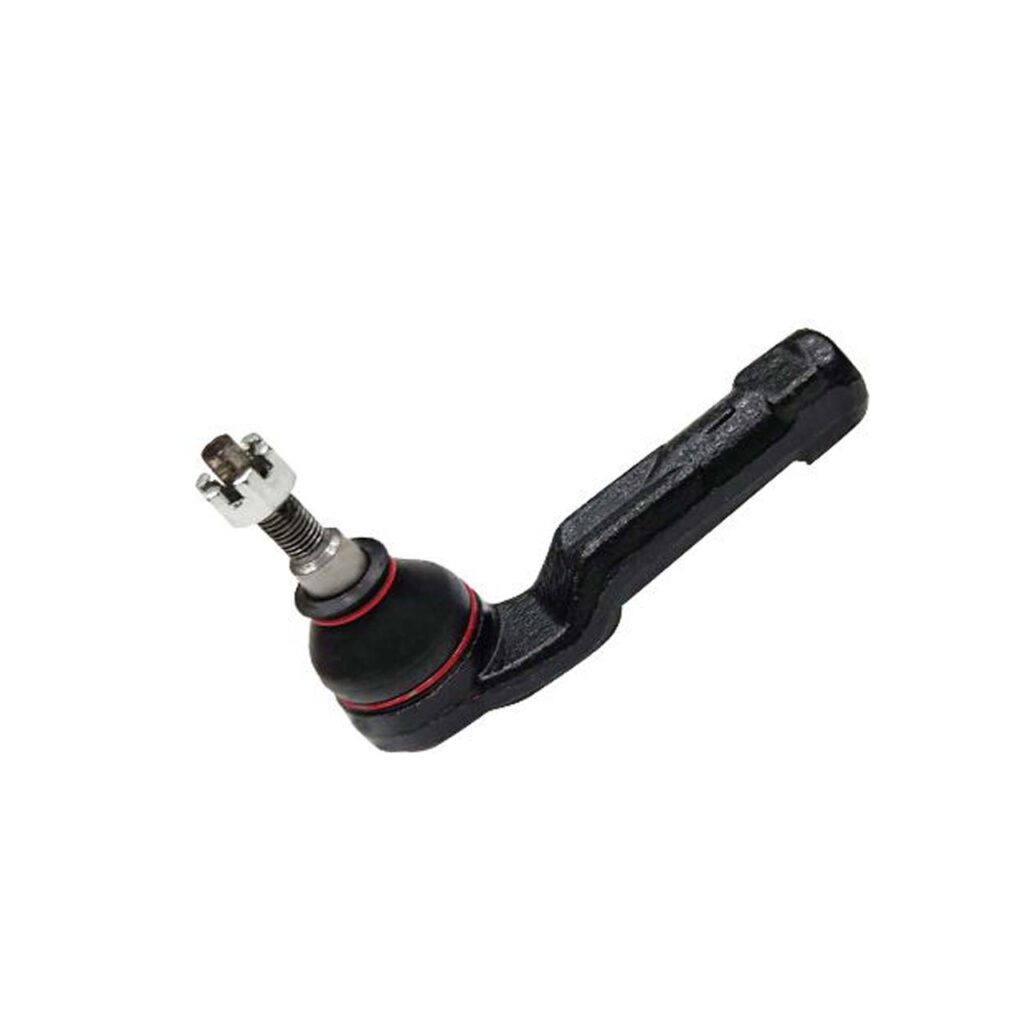
The "ball" is a polished steel stud encapsulated within a "socket," или жилье. This joint is packed with high-pressure grease for lubrication and sealed from the elements by a flexible rubber or silicone boot. This design, simple in concept yet demanding in execution, allows the wheel to turn left and right while also moving vertically with the suspension's travel. This dual-axis movement is what makes the component so indispensable and, simultaneously, so susceptible to wear over time.
Distinguishing Between Inner and Outer Tie Rod Ends
A complete tie rod assembly on most passenger vehicles consists of two primary sections: внутренний конец рулевой тяги и внешний конец рулевой тяги, connected by an adjusting sleeve. Thinking about their names helps clarify their roles.
The inner tie rod end connects directly to the steering rack (in a rack-and-pinion system) or the center link (in a parallelogram steering system). It is located deeper within the engine bay, closer to the vehicle's centerline. Its primary job is to pivot as the steering wheel is turned, initiating the push-or-pull motion.
The outer tie rod end connects to the steering knuckle, which is the part that holds the wheel hub and bearing assembly. This is the component you can most easily see when looking behind the front wheel. It completes the connection, transferring the motion from the inner tie rod to the wheel itself. The adjusting sleeve between them is threaded, which allows a technician to lengthen or shorten the entire tie rod assembly. This adjustment is how the critical "палец на ноге" alignment angle of the front wheels is set.
The Engineering Behind the Ball-and-Socket Joint
The longevity and performance of a tie rod end are dictated by the quality of its fundamental components. The ball stud is typically forged from high-strength alloy steel and then induction-hardened and polished to an incredibly smooth finish to minimize friction. The socket, or bearing surface, it rests in can be made of powdered metal, a durable polymer like polyoxymethylene (POM), or a combination of materials designed for low friction and high wear resistance.
The grease is not just any lubricant. It is a specialized formula designed to withstand extreme pressures and a wide range of temperatures without breaking down. The protective boot is perhaps the most underappreciated part of the assembly. It must remain flexible through millions of cycles of movement, in temperatures ranging from freezing cold to scorching heat, while resisting degradation from road salt, oils, and ozone. A tiny tear in this boot is often the beginning of the end for a tie rod. Once contaminants like water and grit penetrate the boot, they mix with the grease to form an abrasive slurry that rapidly destroys the polished surfaces of the ball and socket, creating looseness, или "play." This is a central reason why the question of how long do tie rod ends last is so dependent on the external environment.
Deconstructing the Lifespan: Как долго служат наконечники рулевых тяг?
The question of a tie rod end's lifespan is not one with a single, definitive answer. It is a question of probabilities and variables, much like asking about the lifespan of a car's tires or brakes. While manufacturers and repair professionals often cite a general range, the actual service life is a product of a complex equation involving material quality, vehicle application, driving environment, and maintenance practices. The expectation for an original equipment manufacturer (ОЕМ) part on a luxury sedan driven on pristine highways is vastly different from that of an economy aftermarket part on a work truck navigating construction sites.
The Manufacturer's Benchmark: 50,000 к 100,000 Miles
As a general baseline, many OEM tie rod ends are designed and tested to last between 50,000 и 100,000 мили (примерно 80,000 к 160,000 километры). Some may even exceed this range under ideal conditions. This benchmark is established through rigorous testing protocols that simulate a lifetime of driving cycles. Однако, "ideal conditions" are rarely encountered in the real world. This range should be viewed not as a guarantee, but as a statistical average from which individual experiences will deviate. Aftermarket parts present an even wider spectrum. Premium aftermarket brands may meet or even exceed OEM specifications, while budget-oriented parts may use lesser-grade materials or less stringent manufacturing tolerances, potentially leading to a shorter service life.
Lifespan Data Across Vehicle Types
The type of vehicle and its intended use impose vastly different loads on steering components. A heavier vehicle requires more force to turn its wheels, placing greater stress on the tie rod ends. Similarly, a vehicle with a performance-oriented suspension will transmit more road feedback, which can also accelerate wear. The following table provides a generalized comparison, but individual results will always vary.
| Тип транспортного средства | Average Lifespan (Miles) | Key Influencing Factors |
|---|---|---|
| Compact Sedan | 70,000 – 100,000+ | Lighter weight, typically smoother driving conditions. |
| Full-Size SUV / Minivan | 50,000 – 90,000 | Higher vehicle weight, increased stress from larger tires. |
| Light-Duty Truck (2WD/4WD) | 40,000 – 80,000 | Heavy loads, potential for off-road use, larger/heavier tires. |
| Performance / Sports Car | 45,000 – 85,000 | Stiffer suspension transmits more road shock, aggressive driving habits. |
| Heavy-Duty Work Truck | 30,000 – 70,000 | Extreme loads, constant use on varied terrains, job site conditions. |
The Influence of Driving Habits on Longevity
Beyond the vehicle itself, the driver is one of the most significant variables in the lifespan equation. An operator who navigates roads with mechanical sympathy—slowing for speed bumps, avoiding potholes, and making smooth steering inputs—will invariably extend the life of their steering and suspension components.
Наоборот, aggressive driving habits can drastically shorten the lifespan. Hitting curbs, even at low speeds, can send a shock load through the steering linkage that damages the internal workings of the tie rod end. Rapid, jerky steering movements put repeated high stress on the ball and socket. Consistently driving over rough, unpaved roads or through pothole-ridden city streets subjects the entire front end to a constant barrage of impacts that accelerate the wear of every component, making the inquiry into how long do tie rod ends last deeply personal to one's driving style.
The 7 Key Warning Signs of a Failing Tie Rod End
A failing tie rod end rarely fails suddenly and without warning. It typically undergoes a period of gradual degradation. During this time, it provides a series of distinct sensory clues to the attentive driver. Recognizing these signs early is paramount not only for maintaining driving pleasure but for ensuring safety. Neglecting them allows a minor issue to escalate into a significant and potentially dangerous one.
Симптом 1: A Wandering or Loose Steering Wheel
This is often the first and most subtle symptom. The driver may notice that the steering wheel feels less connected to the road. There might be a small "dead spot" in the center, where a slight turn of the wheel produces no corresponding change in the vehicle's direction. This is often described as "играть" in the steering. What is happening mechanically is that the worn ball and socket in the tie rod end have developed excessive clearance. The initial steering input is wasted just taking up this slack before the tie rod begins to move the wheel. The vehicle may feel as if it is "wandering" in its lane, requiring constant small corrections from the driver to maintain a straight path.
Симптом 2: Неровная и преждевременная одежда шин
A vehicle's tires are excellent diagnostic tools. Their wear patterns can tell a detailed story about the health of the suspension and alignment. A healthy tie rod end holds the wheel at a precise angle, known as the "палец на ноге" параметр. When the tie rod end becomes loose, it can no longer maintain this setting consistently. The wheel may wobble slightly as it rotates, or it may be angled slightly inward or outward. This causes the tire to be dragged sideways across the pavement with every rotation. The result is a very specific type of wear, often called "feathering" или "scalloping," which you can typically feel by running your hand across the tread. The inside or outside edge of the tire will wear out much faster than the rest of the tread, drastically reducing the tire's lifespan and costing the owner money.
Симптом 3: Audible Noises When Turning
The human ear is highly attuned to changes in a vehicle's normal operating sounds. A worn tie rod end will often announce its presence with distinct noises, particularly at low speeds when background noise from the engine and wind is minimal. When turning the steering wheel while parking or navigating a parking lot, a driver might hear a sharp "компоновка," а "поп," or a dull "thud" from the front of the vehicle. This sound is the ball stud moving around inside the worn socket. The noise may be more pronounced when hitting a small bump while turning, as the suspension movement further jostles the loose joint.
Симптом 4: Front End Vibration
A vibration that can be felt through the steering wheel is another common symptom. This is different from the high-frequency shimmy of an unbalanced tire. A vibration from a loose tie rod end is often more of a coarse shudder and can be intermittent. It is caused by the wheel assembly oscillating due to the excessive play in the joint. This vibration may be more noticeable at certain speeds and can sometimes be felt through the floorboards or the entire chassis. It is the physical manifestation of the instability that the worn component has introduced into the system.
Симптом 5: A Misaligned Front End
Because the tie rod ends are the primary components used to set the front-end toe alignment, their failure directly leads to misalignment. Even if the vehicle was recently aligned, a worn tie rod end will allow the setting to slip. The most obvious sign of this is a crooked steering wheel. To drive straight, the driver may have to hold the steering wheel at a slight angle to the left or right. The vehicle may also "pull" to one side, forcing the driver to apply constant counter-steering pressure to maintain a straight course. A vehicle that consistently pulls to one side after hitting a bump is a classic sign of a worn steering component like a tie rod end.
Симптом 6: Steering Wheel Shake at High Speeds
While vibration can occur at any speed, a noticeable shake or shimmy in the steering wheel that becomes more pronounced as speed increases can also point to a severely worn tie rod end. The forces acting on the wheels increase exponentially with speed. Any small amount of play in the steering linkage is magnified, leading to a dynamic imbalance that translates into a shake felt by the driver. While this symptom is often attributed to out-of-balance tires, it should never be dismissed without a thorough inspection of the steering components. The potential for a worn tie rod to be the cause makes it a significant safety concern at highway speeds.
Симптом 7: The "Dry Park" Test Failure
This is a diagnostic test rather than a symptom experienced while driving, but it is a definitive way to confirm suspicion. With the vehicle parked on a level surface, the engine off, and the parking brake set, have a helper sit in the driver's seat. Kneel down by the front wheel and place your hand gently over the outer tie rod end, feeling where it connects to the steering knuckle. Have your helper rock the steering wheel back and forth just a few inches—just enough to take up the slack, not to turn the wheels. If the tie rod end is worn, you will feel a distinct "компоновка" or movement within the joint with your fingertips. You may also be able to see the ball stud moving within the housing. This physical confirmation of play is a clear indication that the component has failed and requires replacement.
Environmental and Mechanical Factors That Accelerate Wear
The engineered lifespan of a tie rod end is a theoretical value calculated for a controlled environment. In the real world, a host of external factors conspire to shorten that lifespan. These elements introduce stresses and contaminants that the component was not designed to endure indefinitely. Understanding these factors is key to appreciating why the answer to how long do tie rod ends last can vary so dramatically from one vehicle to another, even if they are identical models.
The Corrosive Effect of Road Salt and Moisture
For vehicles operated in regions with cold, snowy winters, road salt and de-icing brines are a formidable enemy. These corrosive agents can degrade the rubber boot that protects the tie rod's joint. Once the boot is compromised—cracked, torn, or hardened—moisture and salt can penetrate the joint. This has a devastating two-fold effect. Первый, the water displaces the grease and begins to corrode the polished steel ball stud and socket. Второй, the salt crystals act as a fine abrasive, grinding away at the internal surfaces with every movement of the steering. This process can turn a healthy joint into a loose, noisy one in a single season. Even in climates without snow, constant exposure to high humidity or coastal salt air can accelerate corrosion.
The Impact of Poor Road Conditions
Imagine the life of a tie rod end on a vehicle that only ever drives on freshly paved highways versus one that navigates the pothole-strewn streets of a major city or travels on rural gravel roads. The difference in accumulated stress is immense. Every pothole, expansion joint, and speed bump sends a sharp impact load through the suspension and steering systems. While the shocks and struts absorb much of this energy, a significant portion is transmitted through the tie rod ends. These repeated, sharp impacts can fatigue the metal components, compress the internal bearings, and eventually lead to failure. It is a death by a thousand cuts, with each jolt contributing to the component's eventual demise.
The Ripple Effect of Other Worn Suspension Components
The suspension is a holistic system where the health of one component affects all others. If other parts like ball joints, control arm bushings, or wheel bearings are worn, they allow excessive movement in the wheel assembly. This unintended movement forces the tie rod end to work harder and move through angles it was not designed for. Например, a worn control arm bushing might allow the entire wheel to shift forward and backward during acceleration and braking. The tie rod end must accommodate this extra movement, placing abnormal stress on its ball and socket. In this way, neglecting one failing part can trigger a cascade of failures throughout the front end.
Aftermarket Modifications: Lifts, Lowering, and Larger Wheels
Enthusiasts often modify their vehicles to enhance performance or aesthetics, but these changes can have unintended consequences for stock suspension components.
- Lift Kits: Lifting a truck or SUV changes the angle of the steering linkage. This new, steeper angle can place the tie rod end in a constant state of bind, restricting its movement and dramatically accelerating wear. Many quality lift kits include drop brackets or specialized steering components to correct this geometry, but inexpensive kits often overlook it.
- Lowering Springs: Similarly, lowering a car changes the suspension geometry and can put the tie rod ends at an extreme angle.
- Larger Wheels and Tires: Fitting wheels and tires that are significantly larger or heavier than the factory-equipped ones increases unsprung weight and leverage. It simply takes more force to turn a larger, heavier wheel, and all of that extra force is transmitted directly through the tie rod ends. The increased rotating mass can also exacerbate any small amount of play, making vibrations and shimmies more pronounced.
A Practical Guide to Inspection and Diagnosis
Accurately diagnosing a faulty tie rod end requires a methodical approach that combines visual inspection with physical testing. While some symptoms may strongly suggest a tie rod issue, it is vital to differentiate it from other potential problems in the suspension system, as many components can produce similar noises or sensations when worn. This diligence prevents misdiagnosis and ensures that the correct repair is performed.
Визуальный осмотр: Что искать
The first step is always a careful visual examination, which can be done with the front wheels on the ground. Use a good flashlight and look for the following:
- Torn or Missing Boot: This is the most critical item to check. The rubber boot encasing the ball joint is the first line of defense. Look for any rips, трещины, or signs of dry rot. If the boot is split open or missing entirely, the joint should be considered failed, as contamination is inevitable.
- Утечка смазки: A healthy boot will contain all the grease. If you see wet, greasy residue caked on the outside of the boot or on the surrounding components, it indicates the boot has a tear or the seal has failed.
- Тяжелая коррозия: While surface rust on the cast metal parts is often normal, look for excessive, flaky corrosion on the tie rod body, adjusting sleeve, or the stud itself. Severe corrosion can weaken the component and make future alignment adjustments impossible.
The Physical Test: Checking for Play
A visual inspection can only tell you so much. The definitive test is to physically check for looseness or "играть" in the joint. There are two primary methods for this:
- The Wheel Wiggle Test: Safely raise the front of the vehicle so the tire is off the ground and support it with jack stands. Grasp the tire at the 3 час и 9 часовые позиции. Try to wiggle the wheel from side to side. There should be no significant play or clunking noise. If you feel movement, have a helper watch the outer tie rod end as you wiggle the wheel. If the tie rod end is moving and clunking before the steering rack begins to move, он изношен.
- The "Dry Park" Тест (Revisited): As described earlier, this is often the most effective test. With the vehicle on the ground, a helper rocks the steering wheel back and forth. You place your hand on the outer tie rod end. Any movement or clunking felt in the joint indicates wear. This test isolates the tie rod end from other suspension components more effectively than the wheel wiggle test.
Differentiating Tie Rod Issues from Other Suspension Problems
Several front-end problems have overlapping symptoms. A methodical process of elimination is key. This table compares common symptoms across three frequently worn components.
| Симптом | Likely Cause: Наконечник рулевой тяги | Likely Cause: Шаровой шарнир | Likely Cause: Wheel Bearing |
|---|---|---|---|
| Лязговой шум | Heard when turning the wheel side-to-side (low speed). | Heard when going over bumps or through dips (vertical wheel travel). | A grinding or roaring noise that changes with vehicle speed, not turning. |
| Steering Feel | Loose, wandering steering; "играть" in the wheel. | Can cause wandering, but often feels like "memory steer" (doesn't return to center). | Not typically associated with steering looseness; may cause pulling. |
| Tire Wear | Feathered wear on the inside or outside edge of the tire (toe issue). | Uneven wear on the inside or outside edge (camber issue). | Can cause uneven wear, but often less distinct than alignment issues. |
| Physical Test | Play detected when wiggling wheel side-to-side (3 & 9 o'clock). | Play detected when wiggling wheel top-to-bottom (12 & 6 o'clock). | No play, but wheel feels rough or gritty when spun by hand. |
Процесс замены: A Matter of Precision and Safety
Once a tie rod end has been diagnosed as failed, replacement is the only option. These are not serviceable parts; they are replaced as a complete unit. While the replacement procedure may seem straightforward to an experienced DIY mechanic, it is a safety-critical repair that has significant implications if performed incorrectly.
Why Professional Replacement is Often Recommended
Replacing a tie rod end involves more than just unbolting the old part and installing the new one. Several factors make this a job best left to a professional technician or a highly experienced home mechanic:
- Specialized Tools: Separating the tapered stud of the tie rod end from the steering knuckle often requires a special tool called a "tie rod end puller" or a "pickle fork." Using a hammer to beat the stud out can damage the steering knuckle or other components.
- Коррозия: On older vehicles or those from salty climates, the tie rod adjusting sleeve and jam nuts can be seized with rust, requiring heat from a torch to loosen—a procedure with its own set of risks.
- The Alignment Imperative: This is the most compelling reason. Замена наконечника рулевой тяги, by its very nature, completely disrupts the vehicle's front-end alignment. Even if one attempts to count the threads to install the new part in the same position, it will not be precise enough. After replacement, the vehicle must have a professional four-wheel alignment performed. Driving without a proper alignment will cause rapid tire wear, плохая управляемость, и может быть небезопасно.
The Consequence of Neglect: From Annoyance to Catastrophe
Continuing to drive on a worn tie rod end is a gamble with escalating stakes. Initially, the consequences are financial: accelerated tire wear and potential damage to other suspension components. The handling becomes sloppy and unpredictable. The ultimate danger, однако, is a complete separation of the joint. If the ball stud wears down enough, it can pull out of its socket, particularly if the vehicle hits a large pothole or curb. Когда это произойдет, the connection between the steering wheel and that wheel is completely severed. The wheel is free to flop in any direction, resulting in an immediate and total loss of steering control on that side. This is a catastrophic failure that can easily lead to a serious accident.
Selecting Quality Replacement Parts
When it comes time for replacement, the choice of part matters. While OEM parts are a reliable benchmark, the aftermarket offers a wide spectrum of quality and price. Investing in a premium component is a wise decision for a safety-critical part. When evaluating options, look for features like induction-hardened studs, durable internal bearings, and high-quality boots. Exploring a catalog of durable tie rod options from a reputable supplier can provide a balance of quality and value. Choosing a well-engineered part is the first step in ensuring the repair will last, restoring the vehicle's safety and handling precision for many miles to come.
Часто задаваемые вопросы (Часто задаваемые вопросы)
Могу ли я ездить с неисправным наконечником рулевой тяги? While it is physically possible to drive with a slightly worn tie rod end, it is strongly discouraged. The condition will only worsen, leading to poor handling, rapid tire wear, and increased stress on other suspension parts. In a case of severe wear, the joint can separate, causing a complete loss of steering control to that wheel, which is extremely dangerous.
Do tie rod ends need to be replaced in pairs? It is not strictly necessary to replace them in pairs (Лево и право) like brakes. Однако, it is often recommended. If one side has failed due to age and mileage, the other side is likely not far behind as it has been subjected to the same conditions. Replacing both at the same time can save on labor costs and the cost of a second wheel alignment down the road.
What is the average cost to replace a tie rod end? По состоянию на 2026, the cost can vary widely based on vehicle make and model, Ставки на рабочую силу в вашем районе, and the part's quality. For a single outer tie rod end, you might expect to pay between $150 и $400, including the part, труд, and the mandatory wheel alignment. Replacing an inner tie rod end is often more labor-intensive and therefore more expensive.
What is the difference between inner and outer tie rod end failure symptoms? The symptoms are largely the same (лязг, свободное рулевое управление, износ шин). A failure is a failure. Однако, a worn inner tie rod, being connected directly to the steering rack, can sometimes produce a clunking noise that seems to come from deeper in the engine bay, rather than directly behind the wheel. Diagnosis requires a physical inspection to pinpoint the source of the looseness.
How long does it take to replace a tie rod end? For a professional technician with the right tools, replacing a single outer tie rod end can take about 30 к 60 минуты. This does not include the time for the wheel alignment, which typically adds another 45 к 60 minutes to the total service time. If components are heavily rusted or seized, the job can take significantly longer.
Is a wheel alignment really necessary after replacing a tie rod? Да, абсолютно. It is not optional. The tie rod is the component used to set the toe alignment. Removing and replacing it makes it impossible to restore the exact original alignment. Driving without an alignment will cause the vehicle to handle poorly, pull to one side, and destroy your tires in a very short amount of time.
Заключение
The integrity of a vehicle's steering system is a non-negotiable aspect of its safe operation. Within this system, the tie rod end functions as a small but profoundly important component, translating driver inputs into directional control. While a general lifespan of 50,000 к 100,000 miles serves as a useful reference, the actual service life is a narrative written by road conditions, driving habits, and maintenance vigilance. The audible clunks, the subtle wander in the steering, and the tell-tale wear on a tire's edge are not mere annoyances; they are direct communications from the vehicle about a developing mechanical frailty. Heeding these warnings and addressing them with a proper diagnosis and high-quality parts, такой как premium tie rod end replacements, is fundamental to responsible vehicle ownership. It is a process that restores not only the precision of the vehicle's handling but also the confidence of the person behind the wheel.
Ссылки
JCMSTECH Research Team. (2026, январь 13). Руководство по контролю над оружием: Что они делают, типы, симптомы & как выбрать. Компания автозапчастей JCM., ООО.
LKCONTROLARM. (2024, Декабрь 9). Understanding the functions and importance of control arms and tie rods in vehicles. https://www.lkcontrolarm.com/hmn/news/controlarmandtierod-16545.html
Ронг, Э. (2026, февраль 27). Полное руководство по деталям передней подвески: Диаграмма, компоненты & функция (2026). GDST. https://gdstauto.com/the-ultimate-guide-to-front-suspension-parts/
Ронг, Э. (2026, Маршировать 17). Complete guide to control arms: Функция, типы, problems & замена. GDST. https://gdstauto.com/control-arm-guide/
Topshine Auto Parts. (2026, январь 14). A comprehensive analysis of the control arm, a core component of automotive suspension. https://www.topshineparts.com/a-comprehensive-analysis-of-the-control-arm-a-core-component-of-automotive-suspension/